


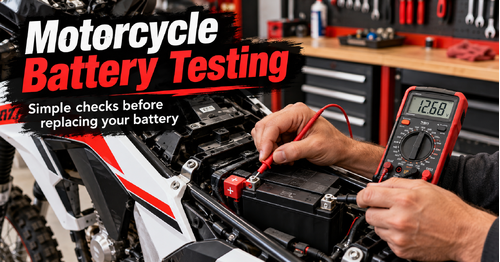

Has your motorcycle battery gone flat, or have you fitted a new battery only to find the bike won't start again a few weeks later?
It's easy to assume the battery is faulty. But a flat motorcycle battery can have several causes, including infrequent riding, an electrical drain, poor connections or a problem with the bike's charging system.
Replacing a battery without finding out why the first one went flat can leave you with exactly the same problem.
The good news? You can carry out several useful checks at home with a basic multimeter. This guide explains what to test, what the readings mean, how different battery types behave and when you might need professional help.
Safety first: This guide covers 12V motorcycle starting batteries. Keep tools clear of both battery terminals, work in a ventilated area and avoid sparks. Never attempt to charge a swollen, leaking, frozen, damaged or unusually hot battery. Check your battery and motorcycle manuals before testing.
1. Before You Test: Is It Really the Battery?
First, identify what happens when you try to start the motorcycle.
- Nothing happens or the starter barely turns: The battery, terminals, starter circuit or a safety switch may be involved.
- The starter turns slowly or you hear clicking: Low battery charge or a poor electrical connection is possible.
- The engine turns over normally but won't start: Don't automatically blame the battery. The problem may involve fuel, ignition or another system.
Before reaching for the multimeter, check that the battery terminals are clean and secure. Also check the kill switch, side stand, clutch switch and other starting interlocks fitted to your motorcycle.
2. Know Your Battery Type: Lead-Acid, AGM or Lithium
This is an important step because not all motorcycle batteries should be charged or tested in exactly the same way.
Firestorm sells conventional lead-acid, AGM and lithium starting batteries, including options from SSB and Motobatt. Look at the label on your battery to identify its type and model before choosing a charger or interpreting voltage readings.
Fully charged: Commonly around 12.6–12.8V after resting.
Charger: Suitable conventional lead-acid programme.
Fully charged: Often around 12.8–13.0V, depending on the model.
Charger: AGM-compatible programme.
Fully charged: Typically above 13V, but resting voltage alone is a less precise state-of-charge indicator.
Charger: Follow the exact lithium manufacturer's instructions.
What Is the Difference Between AGM and Lead-Acid?
AGM is actually a type of lead-acid battery. Both use lead-acid chemistry, but AGM batteries hold the electrolyte in absorbent glass mats rather than as free liquid.
This generally makes AGM batteries better suited to vibration, compact motorcycle installations and low-maintenance use. However, they still need correct charging and can suffer damage when left discharged.
What Makes Lithium Different?
Many modern motorcycle lithium batteries use LiFePO4 chemistry. They are generally lighter than equivalent lead-acid batteries and have different charging characteristics.
A lithium battery's voltage may remain relatively steady through much of its discharge cycle. That means a simple voltage reading often tells you less about its remaining capacity than it would for a conventional lead-acid battery.
Some lithium batteries also contain electronic protection circuits or a Battery Management System (BMS). We'll explain how this can affect testing later in the guide.
Important: A 12.6V resting reading might be reasonable for some lead-acid batteries but unusually low for certain lithium batteries. Never use the same voltage chart to judge every battery type.
3. Fully Charge the Battery Before Testing
This is one of the most important steps, and one that's often overlooked.
A discharged battery cannot be properly assessed for starting performance simply by checking its resting voltage. First, charge it using a charger suitable for its chemistry and capacity.
Charging Conventional Lead-Acid Batteries
Use a charger designed for conventional lead-acid batteries of the appropriate voltage and capacity. If your battery has serviceable cells, follow its instructions for electrolyte maintenance.
Never open a battery marked sealed or maintenance-free, and never add water or acid unless the manufacturer specifically instructs you to do so.
Charging AGM Batteries
Choose an automatic charger with a suitable AGM charging programme.
For example, Motobatt recommends charging its Quadflex AGM batteries before installation and checking that the settled resting voltage is approximately 12.8–12.85V.
Some AGM batteries require a different charging profile from conventional flooded lead-acid batteries. Follow the battery manufacturer's instructions rather than assuming every lead-acid charger is suitable.
Charging Lithium Batteries
For SSB lithium batteries, follow the specific product instructions and use an approved lithium-compatible charger. Other manufacturers, including Motobatt, may permit certain additional charging methods for particular products.
The safest general choice is a charger specifically approved for your battery's lithium chemistry and model.
Do not use lead-acid desulphation, reconditioning or equalisation modes on lithium batteries unless the lithium battery manufacturer explicitly approves that procedure.
Some lithium batteries can be damaged by unsuitable charging voltage, excessive charging current or incorrect recovery procedures.
- Read the battery label and identify its chemistry and model.
- Choose a charger compatible with the battery and follow any instructions about charging on or off the motorcycle.
- Allow the approved charging cycle to complete.
- Disconnect the charger and let the battery rest for the period specified by its manufacturer before measuring resting voltage.
Rider tip: Don't assume a newly purchased battery is fully charged. Depending on its chemistry, storage time and manufacturer instructions, it may need charging before installation.
Explore Firestorm's motorcycle battery chargers and maintainers, including models designed for AGM and lithium batteries.
4. Check Battery Voltage With a Multimeter
A digital multimeter can tell you the battery's resting voltage. For lead-acid batteries, this is a useful first indication of the state of charge.
Typical Resting Voltage: Conventional Lead-Acid
For many conventional 12V flooded lead-acid batteries, the following figures are useful approximate references after the battery has rested.
| Resting voltage | What it suggests |
|---|---|
| Around 12.6–12.8V | Fully charged or close to fully charged. |
| Around 12.4V | Partly discharged. Recharge and retest. |
| Around 12.2V | Significantly discharged. Recharge before further assessment. |
| 12.0V or less | Very low charge. Extended discharge may have damaged the battery. |
How to Interpret AGM and Lithium Readings
| Battery type | Resting voltage guidance |
|---|---|
| Conventional lead-acid | Usually around 12.6–12.8V when fully charged. |
| AGM | Often around 12.8–13.0V when fully charged. Motobatt Quadflex AGM specifies approximately 12.8–12.85V after settling. |
| Lithium LiFePO4 | Commonly above 13V when well charged, but voltage-based state-of-charge estimates are model-dependent. Check the manufacturer's specification. |
These figures are indicative, not universal pass/fail thresholds. Temperature, recent charging, electrical load and battery design all affect voltage readings.
Remember: A battery can show a good resting voltage yet still struggle to supply enough power to start the motorcycle.
5. Test the Battery While Starting the Bike
A motorcycle battery has to deliver a substantial burst of current to operate the starter motor. This is called cranking.
A battery may show a healthy resting voltage but drop excessively when the starter is operated. That can indicate a weak battery or a problem elsewhere in the starting circuit.
- Start with a fully charged battery.
- Keep the multimeter connected to the battery terminals on the DC volts setting.
- Have someone operate the starter briefly while you watch the display.
- Record the lowest voltage reading and whether the engine cranked at its normal speed.
What About the 9.6V Cranking Test?
You may have heard that a good battery should never drop below 9.6V when starting.
That figure is commonly used as a reference in controlled lead-acid load testing, typically under specified temperature, current and test-duration conditions.
An unusually low voltage during cranking can be a useful warning sign, but 9.6V is not a universal pass/fail threshold for every motorcycle battery or lithium system.
If cranking voltage is poor, arrange an appropriate battery load or conductance test. Also check the battery cables, earth connections and starter circuit.
Remember: Resting voltage indicates charge condition more than starting capacity. A correctly performed load or conductance test provides better information about battery health. Testing methods must suit the battery chemistry.
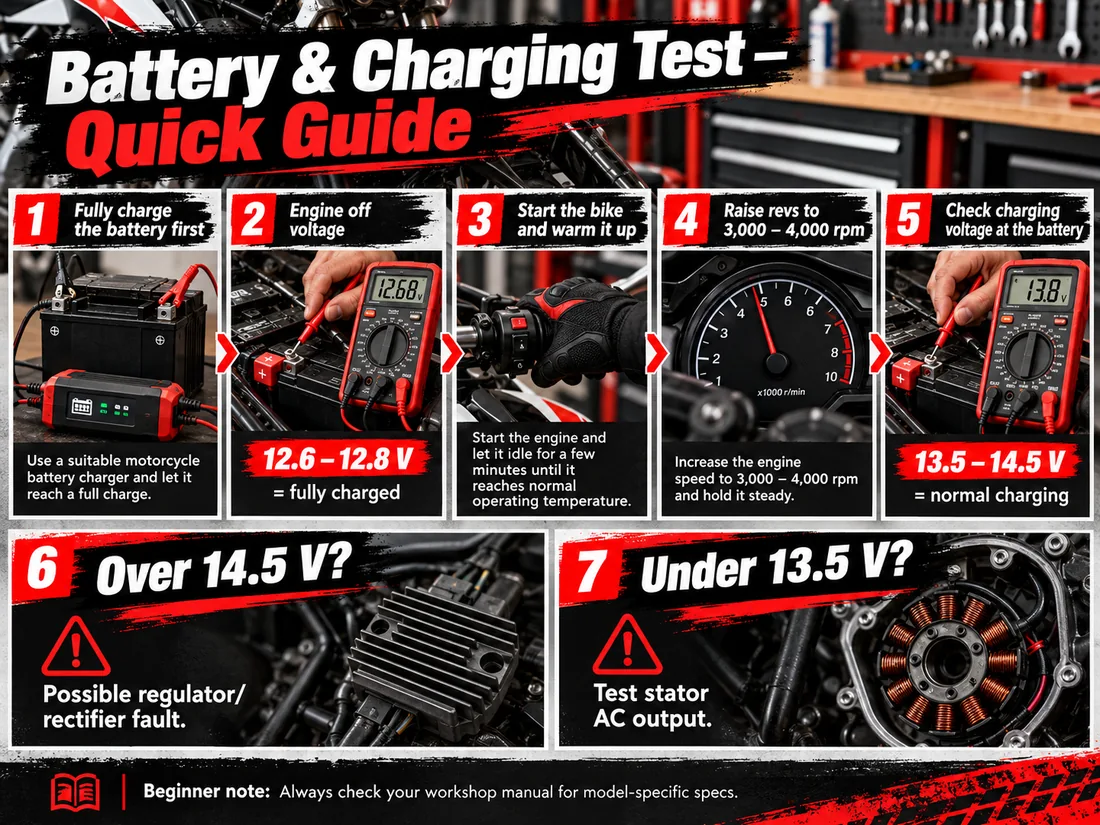
6. Check the Motorcycle Charging System
Now we want to know whether the motorcycle is charging the battery while the engine is running.
A healthy battery can still go flat if the motorcycle's charging system isn't supplying enough power to replace what the bike uses.
- Start with a fully charged battery.
- Keep the multimeter connected across the battery terminals and set to DC volts.
- Start the motorcycle and allow the engine to warm up.
- Measure voltage at idle, then at the engine speed specified in your motorcycle's service manual. On many motorcycles, a check may be made around 3,000–4,000 rpm.
- Record the readings and compare them with the motorcycle manufacturer's charging specification.
What Charging Voltage Should You See?
On many motorcycles with a conventional 12V charging system, approximately 13.5–14.5V is a useful general reference at the specified engine speed.
However, different motorcycles and battery systems may have different charging-voltage requirements. Some motorcycle charging systems also operate differently at idle compared with higher engine speeds.
| Test result | What to investigate |
|---|---|
| Within specification | Charging voltage appears normal under the conditions tested. |
| Below specification | Possible charging, wiring, connection, stator or regulator/rectifier problem. |
| Above specification | Possible voltage-regulation or wiring fault requiring further diagnosis. |
A reading outside the specified range is a reason to investigate. It does not, by itself, prove that the stator or regulator/rectifier needs replacing.
Does Lithium Need a Different Charging-System Test?
The basic multimeter procedure is similar, but the interpretation requires care.
Check that the motorcycle's charging voltage is within the limits approved for both the motorcycle and the particular lithium battery. Not every lithium replacement battery is suitable for every charging system.
If the voltage is too high or too low, investigate compatibility and possible charging-system faults before fitting another battery.
7. Why Does a New Motorcycle Battery Go Flat Again?
This is one of the most common frustrations with motorcycle batteries. A rider replaces a flat battery, the motorcycle starts normally, and then the new battery goes flat as well.
In some cases, the battery has simply been discharged by the way the motorcycle is used or stored. In others, there may be an electrical fault that needs attention.
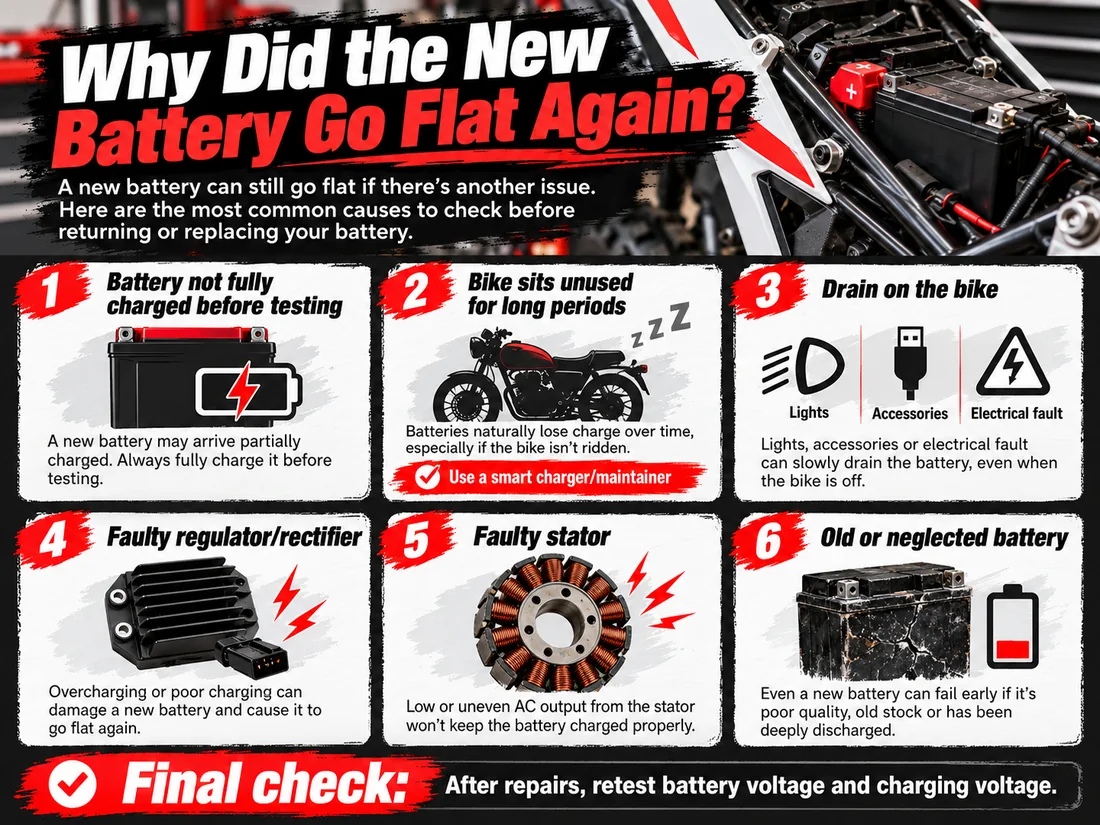
The Most Common Causes
- The bike sits unused: Batteries naturally lose charge over time. Some motorcycles also draw a small amount of power while parked.
- Lots of short rides: Repeated starts and very short trips may not allow the charging system enough time to replenish the battery.
- Electrical accessories: USB chargers, alarms, trackers or incorrectly wired equipment may continue drawing power with the ignition switched off.
- Poor connections: Loose or corroded battery terminals and earth connections can cause starting and charging problems.
- Charging-system faults: Problems with the stator, regulator/rectifier or wiring may prevent proper charging or cause overcharging.
- Previous deep discharge: A battery repeatedly or deeply discharged may lose capacity or suffer permanent damage.
If the motorcycle is only ridden occasionally, a suitable automatic battery maintainer or the manufacturer's recommended storage procedure can help keep the battery ready for your next ride.
Browse Firestorm's motorcycle battery chargers and maintainers, including suitable options for different battery chemistries.
8. Lithium Battery Appears Dead? Check for Protection Mode
Some lithium motorcycle batteries contain a Battery Management System (BMS) or another electronic protection circuit.
Depending on the design, this circuitry may disconnect or limit the battery's output if it detects conditions such as excessive discharge, overcurrent or abnormal temperature.
This can sometimes make a lithium battery appear completely dead, even when the battery may be recoverable using the manufacturer's approved procedure.
What Should You Do?
- Identify the battery model: Check the label and manufacturer's instructions to see what protection features the battery actually has.
- Check for signs of damage: Do not attempt charging if the battery is swollen, leaking, excessively hot or physically damaged.
- Follow the approved recovery procedure: Some batteries require a charger with a compatible lithium recovery function or a specific reset process.
- Investigate why it discharged: Even if the battery recovers, an electrical drain or charging fault may cause the same problem again.
Important: Not all lithium motorcycle batteries have a BMS, and not all protection circuits operate the same way. Never bypass a protection system or attempt improvised charging or jump-starting to wake a deeply discharged lithium battery.
What About Lithium Batteries in Cold Weather?
Lithium starting batteries can behave differently from lead-acid batteries in very cold conditions. Some may deliver reduced cranking performance when cold, even when adequately charged.
Certain manufacturers provide specific cold-start procedures. Always follow the battery's instructions rather than assuming that repeated long starting attempts are safe.
Also check the manufacturer's charging-temperature restrictions. Some lithium batteries must not be charged below certain temperatures unless their design specifically permits it.
9. Could Something Be Draining the Battery While Parked?
Yes. This is known as parasitic current draw.
Some motorcycles have normal standby electrical consumption from clocks, security systems and electronic control units. Excessive current draw, however, can gradually flatten the battery while the bike isn't being used.
You may suspect a drain if:
- The battery tests well after charging but repeatedly goes flat while parked.
- The problem started after installing an electrical accessory.
- The motorcycle starts normally when used regularly but struggles after sitting for days or weeks.
Testing parasitic current normally requires measuring current correctly in the electrical circuit. This is more advanced than the voltage checks above and can damage a multimeter or motorcycle electronics if performed incorrectly.
For beginners, the safest next step is to ask a qualified motorcycle technician to check standby current against the manufacturer's specification.
Useful test: A technician may compare the battery's behaviour while connected to the motorcycle with its behaviour when safely isolated. This can help distinguish a battery that loses charge on its own from one that is being discharged by the bike.
10. Advanced Testing: Stator and Regulator/Rectifier
If charging voltage is outside specification and the battery and wiring have been checked, the stator and regulator/rectifier may need further testing.
The stator generates electrical power on many motorcycles. The regulator/rectifier converts and regulates this power so the electrical system and battery receive a suitable DC voltage.
Some motorcycles use a three-phase stator with three output wires. On these systems, technicians may measure AC voltage between each pair of stator wires and compare the results.
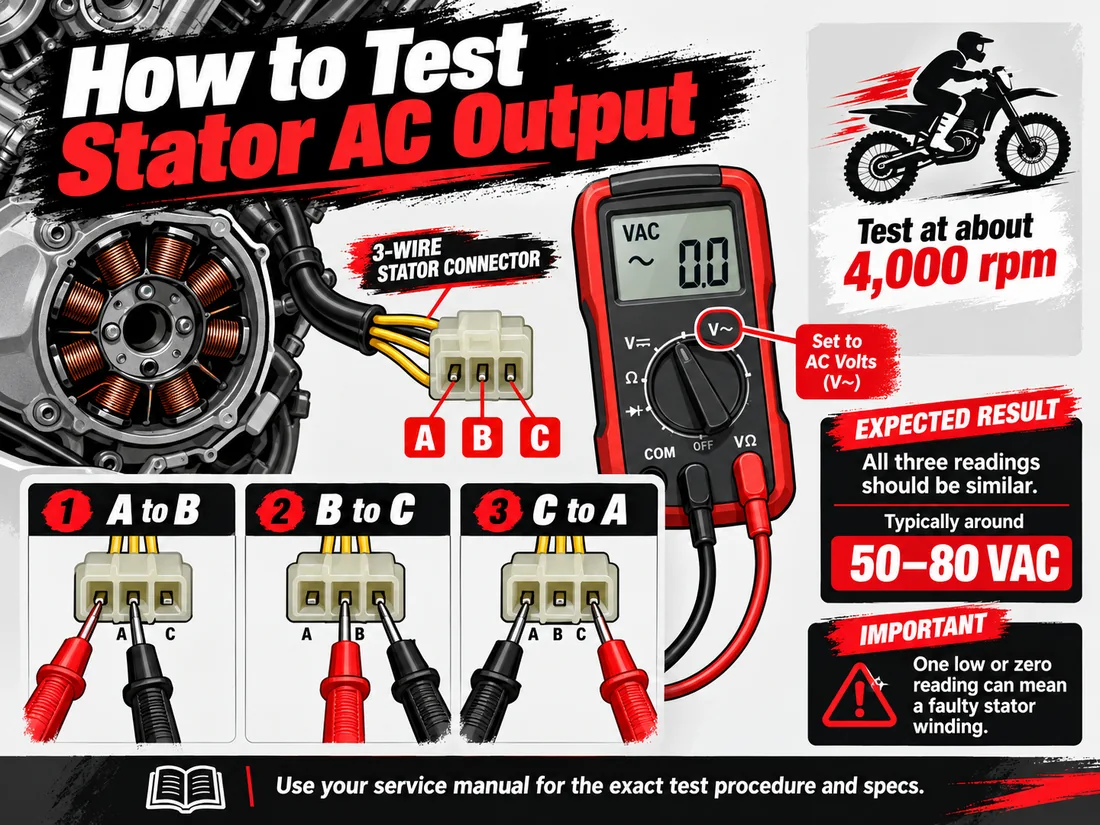
For a suitable three-phase system, the three measurements should generally be compared with one another and with the motorcycle manufacturer's specifications.
Other checks may include winding resistance, insulation to ground, wiring continuity and regulator/rectifier diode testing.
These tests can involve exposed electrical connections and potentially hazardous voltages while the engine is running. If you're not experienced with electrical testing, leave this stage to a qualified motorcycle technician.
If a fault is confirmed, Firestorm offers regulators and rectifiers and RMStator electrical components for a wide range of motorcycles.
11. How to Stop Your Motorcycle Battery Going Flat
A few simple habits can make a big difference to battery life, particularly if your road bike, dirt bike or adventure bike isn't ridden every week.
- Use a suitable smart maintainer: Choose one compatible with your battery chemistry and follow the manufacturer's storage recommendations.
- Don't leave the battery deeply discharged: Recharge promptly using the correct charger and procedure.
- Check your accessories: Ensure electrical accessories don't remain powered unnecessarily when the motorcycle is switched off.
- Keep connections secure: Inspect terminals, cables and earth points for corrosion or looseness.
- Check the charging system: Particularly if a replacement battery repeatedly goes flat.
- Follow the battery manufacturer's instructions: AGM, conventional lead-acid and lithium batteries do not all have identical charging or storage requirements.
Different Battery Types Need Different Storage Care
Conventional lead-acid and AGM batteries benefit from being kept adequately charged during storage. Motobatt specifically warns against leaving its AGM batteries connected to a motorcycle for extended periods without suitable maintenance charging.
Lithium batteries often have low self-discharge when disconnected, but they can still be flattened by motorcycle standby loads. Some lithium manufacturers recommend isolating the battery or periodically checking voltage rather than leaving an unsuitable charger attached.
Follow the storage and maintenance guidance for your particular battery. Don't assume the same routine works for every battery type.
Battery lifespan also varies with usage, temperature, charging, storage and battery chemistry. No specific lifespan is guaranteed for every motorcycle battery.
12. Before Returning a Battery as Faulty
If your motorcycle battery isn't performing as expected, a few checks can help identify the problem before arranging a return or warranty assessment.
- Confirm the battery is the correct model, specification and chemistry for your motorcycle.
- Identify whether it is conventional lead-acid, AGM or lithium.
- Check that the terminals and cables are clean and secure.
- Charge the battery using a compatible charger and the correct programme.
- Record its resting voltage after the recommended settling period.
- Check starting performance and arrange an appropriate load or conductance test if necessary.
- Check the motorcycle's charging voltage against its service manual.
- Consider whether the bike sits unused, has accessories drawing power or may have a charging fault.
- For lithium batteries, check the manufacturer's guidance on protection modes and approved recovery procedures.
Keep a note of your results. Battery brand, model, chemistry, age, charging history and test results can help Firestorm investigate the problem more efficiently.
A battery that is simply discharged may recover after correct charging. However, one that cannot accept or retain charge, or cannot deliver adequate starting power, may need further assessment or replacement.
A flat battery isn't automatically a manufacturing defect, but it doesn't automatically rule one out either. The results need to be considered alongside the battery's condition, history and the motorcycle's electrical system.
Still Having Battery Problems? We're Here to Help
If you've charged and tested your battery, checked the motorcycle's charging system where practical and it still appears faulty, the Firestorm team can help with the next steps.
Before sending a battery back, please review our Returns & Warranty Information and contact us to arrange the appropriate assessment.
Having your order details, battery brand and model, battery type and any voltage or load-test results available can help us investigate the issue and avoid unnecessary delays.
Remember: A discharged battery does not automatically establish whether a manufacturing defect exists. Faults and warranty claims should be assessed on their merits, and your rights under Australian Consumer Law continue to apply.
Motorcycle Battery Questions: Quick Answers
Does 12 volts mean my motorcycle battery is fully charged?
No. For a typical 12V conventional lead-acid battery, a rested reading of 12.0V generally indicates a significantly discharged battery. AGM and lithium batteries have different voltage characteristics, so check the manufacturer's specifications.
Can a brand-new motorcycle battery be flat?
Yes. A battery may lose charge during storage or after being installed in a motorcycle that isn't used regularly. It may also be discharged by a charging-system or electrical fault. Charge and test it correctly before deciding what caused the problem.
Will starting my motorcycle for a few minutes recharge the battery?
Not necessarily. Starting uses battery power, and a short period of idling may not replace what was used. A compatible charger is generally a more reliable way to restore a discharged battery.
Can an AGM battery be charged with a normal lead-acid charger?
Some chargers support both conventional and AGM batteries, while others use different programmes. Check that the charger is approved for AGM and suitable for your battery's size and specifications.
Can I use a normal battery charger on a lithium motorcycle battery?
Not automatically. Some chargers and battery models permit particular charging methods, but others require a specific lithium-compatible programme. For SSB lithium products, follow the product instructions and use an approved lithium charger. Do not assume lead-acid repair or desulphation modes are safe.
Why does my lithium battery show no voltage?
On some lithium models, a protection circuit may have disconnected the output after a deep discharge or another abnormal condition. Not all lithium batteries have this feature. Check the manufacturer's approved diagnosis and recovery instructions before attempting to recharge.
Can a battery be faulty even if the multimeter shows good voltage?
Yes. Resting voltage doesn't fully measure a battery's ability to deliver starting current. A suitable load or conductance test can provide more useful information about battery condition.
Should I replace my regulator/rectifier if charging voltage is low?
Not without further testing. Low charging voltage may be caused by the stator, wiring, connections, battery condition or regulator/rectifier. Diagnose the fault before replacing components.
Find Motorcycle Batteries and Charging Products at Firestorm
Whether your battery needs maintaining or you've confirmed it's time for a replacement, Firestorm offers conventional, AGM and lithium motorcycle batteries, chargers and electrical components to suit a wide range of road, trail and adventure motorcycles.
Explore battery and electrical products and confirm the correct application for your motorcycle's make, model and year. Check charger compatibility with your battery type.
Final tip: If your motorcycle battery keeps going flat, don't just keep replacing it. Identify the battery type, charge it correctly, test its condition and investigate what may be draining it. A few sensible checks now could save time, money and another frustrating no-start situation before your next ride.